
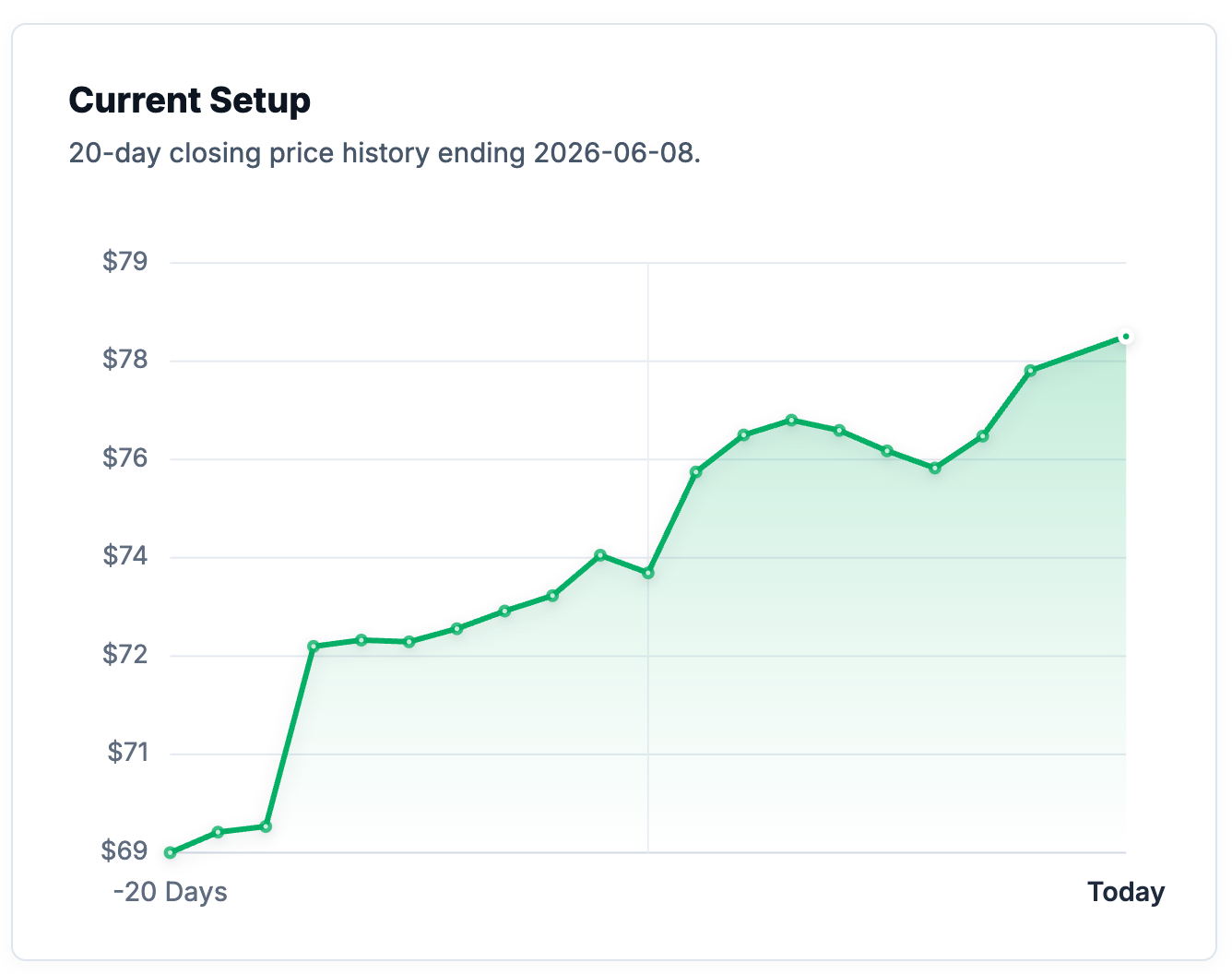
Executive Summary
- EdgeAtlas identified a moderately bullish skew with elevated downside risk for Henry Schein, Inc. (HSIC) on 2026-06-08.
- The analysis used 62 historical matches across 62 unique symbols.
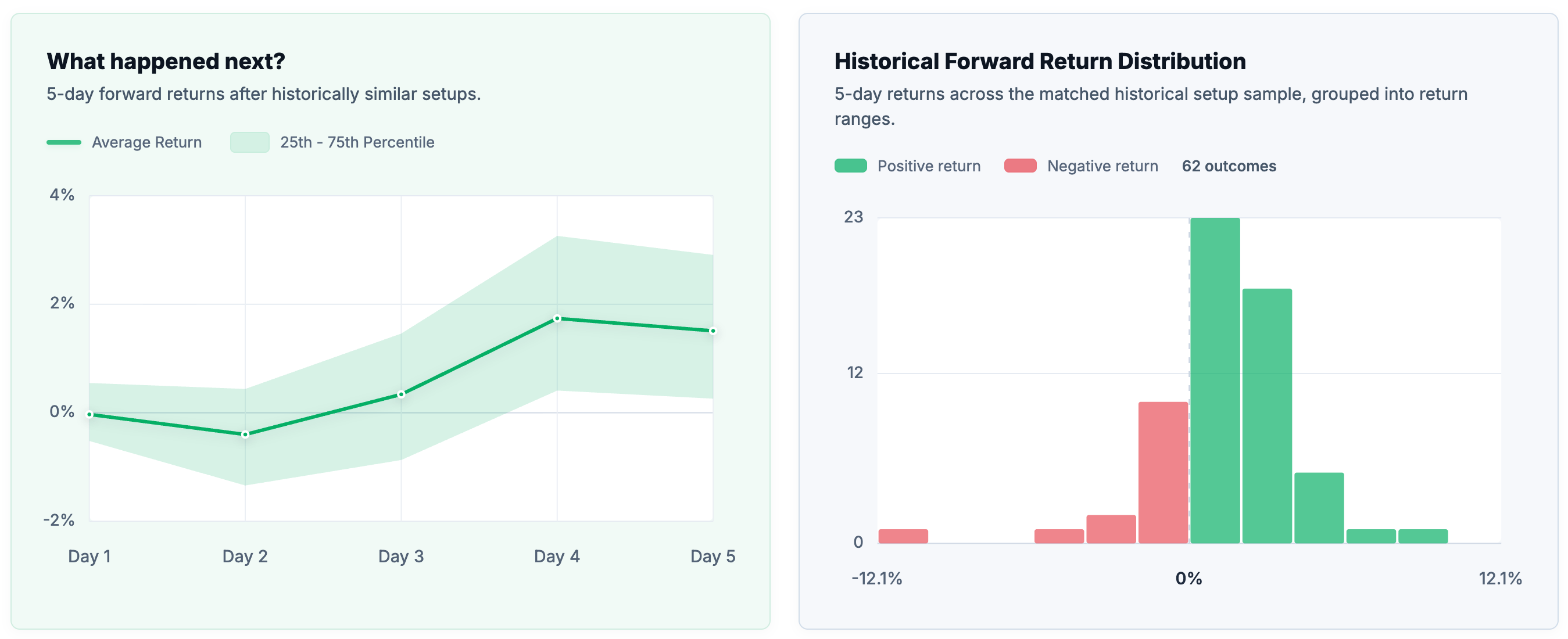
- Similar setups finished positive 77.4% of the time over the next 5 trading days.
- Average historical return was +1.5%; median historical return was +1.7%.
- The worst historical outcome was -10.5%, making tail risk a key part of the setup.
- The most important observation is that similar setups historically leaned positive over 5 trading days, but downside risk was large enough that position sizing and risk control would matter.
Quick Answer
EdgeAtlas found a moderately bullish historical setup for Henry Schein, Inc. (HSIC) on 2026-06-08. Across 62 similar historical setups, the next 5 trading days finished positive 77.4% of the time, with an average return of +1.5% and a median return of +1.7%.
The setup had high reliability and strong match quality, based on a median overall match score of 5/5 and a median shape similarity score of 5/5. That means the historical analogs were structurally close to the current market pattern, not just loosely similar price moves.
The useful takeaway is not a prediction. It is historical context. Similar market structures have produced a clear outcome tendency, but the distribution also shows meaningful tail risk that traders would need to account for.
What EdgeAtlas Observed
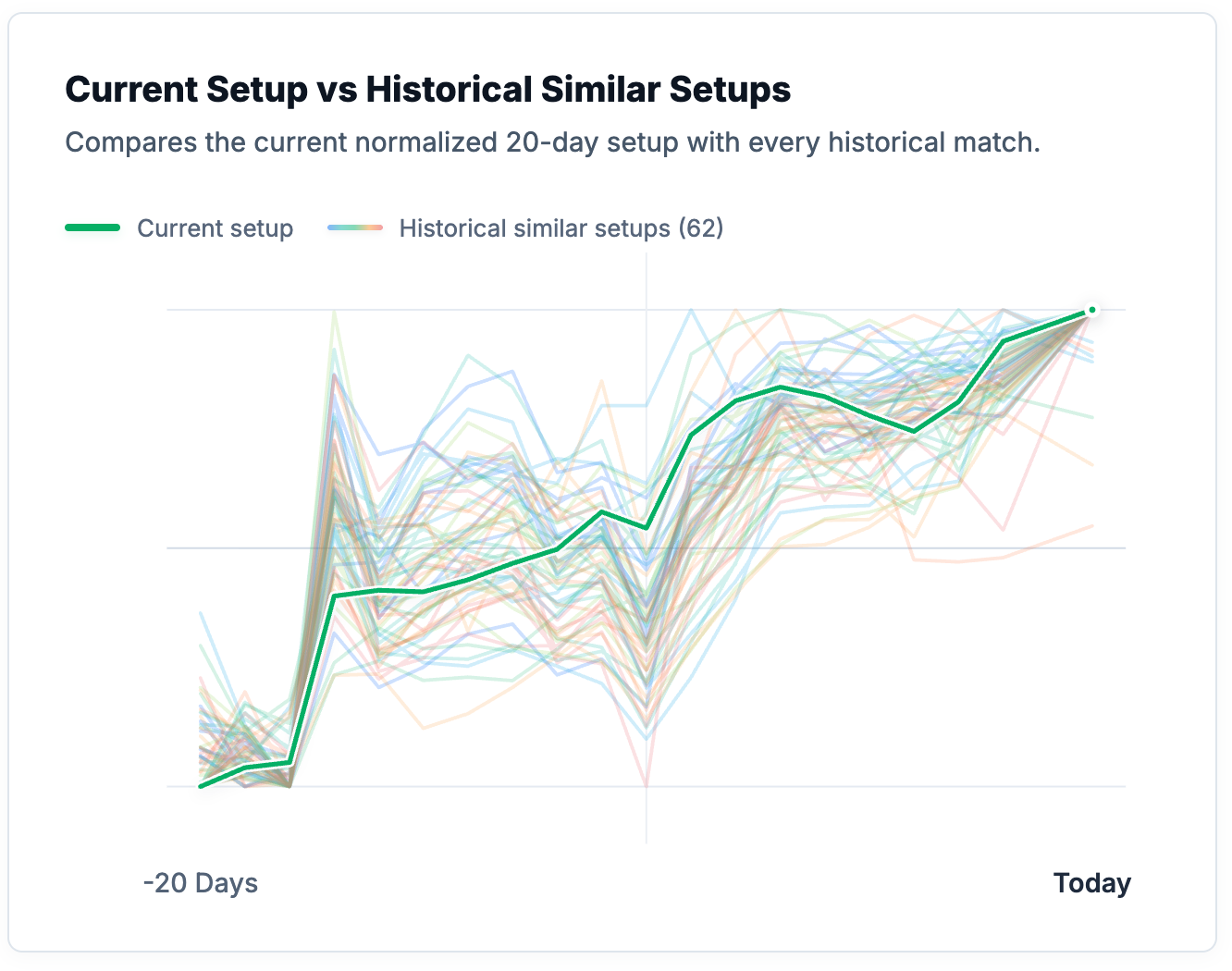
EdgeAtlas compared the current 20-day setup in Henry Schein, Inc. (HSIC) against decades of market history across thousands of stocks. The system found 62 statistically similar historical setups and then measured what happened over the following 5 trading days.
The current setup was selected because the price structure, trend behavior, range position, volatility profile, and risk characteristics closely resembled prior market conditions. The historical matches were not limited to HSIC; they came from a broad cross-market set, which helps show whether this type of structure has appeared elsewhere in market history.
For traders, the immediate point is simple: this is a historical stock analysis of similar setups, not a forecast. It shows how prior occurrences behaved, including both the central tendency and the downside tail.
Key Statistics
- Historical Matches: 62
- Positive Return Rate: 77.4%
- Average Return: +1.5%
- Median Return: +1.7%
- Worst Return: -10.5%
- Reliability: high
- Match Quality: strong
The statistics show a setup with bullish moderate historical behavior, moderate consistency, and high tail risk. The match quality was strong, which improves the usefulness of the comparison, but the worst-case outcome still matters because historical similarity does not remove event risk or regime risk.
Understanding The Metrics
Positive Return Rate measures the percentage of historical matches that produced a positive return over the forward analysis window.
Match Quality measures how closely the prior setups resembled the current market structure. It considers shape, trend, volatility, range position, volume, and risk characteristics.
Reliability reflects the quantity, diversity, and consistency of the supporting historical evidence. A high-reliability label means the setup has enough historical depth to be more useful than a thin-sample pattern.
Why This Setup Is Interesting
The strongest message in this HSIC stock analysis is not simply that the historical win rate was high. It is that the median outcome was slightly stronger than the average, which means the positive skew was not dependent on one or two extreme winners. The central tendency was constructive, and the historical evidence base was broad enough to treat the observation as more than a thin-sample curiosity.
The more practical point is the balance between historical tendency and downside exposure. A setup can have a favorable tendency and still demand discipline if the losing tail is large. For Henry Schein, Inc. (HSIC), the historical outcome distribution shows that the setup should not be judged by direction alone. The quality of the payoff distribution matters.
This is where historical market patterns become useful. The chart may show a recognizable short-term structure, but the historical record shows how similar structures actually behaved afterward. That helps separate a visually appealing setup from one with a measurable risk profile.
What An Experienced Trader Might Notice
- The 77.4% positive rate is supported by 62 matches, not a tiny sample.
- The median return of +1.7% was above the average return of +1.5%, so the result was not mainly driven by a single upside outlier.
- The weak point is the left tail: the worst 5-day historical outcome was -10.5%, which is large compared with the typical gain.
- The setup looks more like a controlled short-term historical edge than a clean breakout signal.
Cross-Market Context
The strongest cross-market matches included DLTR, OXY, AJG, ED, WMT, COST, MA, XYL. These matches came from different industries and business models, including retail, energy, insurance, utilities, payments, industrial technology, software, financials, and consumer-related names.
That variety matters. Cross-market analysis is useful because similar market structures can appear in unrelated stocks when positioning, volatility, trend repair, and range behavior line up. A dental distribution company and a retailer do not need to share the same fundamentals to share a similar short-term market structure.
For Henry Schein, Inc. (HSIC), the cross-market matches suggest the current setup is less about one company-specific story and more about a recurring market behavior pattern. That is one of the advantages of looking beyond single-stock chart history.
Historical Outcome Characteristics
Most outcomes clustered in a moderate range, with the interquartile band running from +0.3% to +2.9%. The broad 10th-to-90th percentile range ran from -1.5% to +4.2%, showing that the common historical path was positive but not risk-free.
The outcome path also showed timing variation. The average return was weaker early in the forward window and became more defined by day four and day five. That means the historical tendency was not always immediate. Some matching setups needed several sessions before the forward outcome became clear.
The limitation is important: even strong historical matches can fail. The presence of a large adverse excursion shows that similar setups sometimes moved sharply against the historical tendency before, during, or after the five-day window.
Current Setup vs Historical Matches
Historical Outcome Distribution
Key Takeaways
- Henry Schein, Inc. (HSIC) had 62 similar historical setups in the EdgeAtlas database.
- The historical positive return rate was 77.4%, with average and median returns of +1.5% and +1.7%.
- Match quality was strong, with a median overall score of 5/5.
- The worst historical outcome was -10.5%, so the tail risk should not be ignored.
- The setup is best read as historical context, not as a directional forecast.
Frequently Asked Questions
What did EdgeAtlas find?
EdgeAtlas found 62 historically similar setups for Henry Schein, Inc. (HSIC) as of 2026-06-08. The setup showed moderately bullish skew with elevated downside risk over the next 5 trading days.
How many similar setups were found historically?
EdgeAtlas found 62 usable historical matches across 62 unique symbols.
What were the typical historical outcomes?
The average historical return was +1.5%, and the median historical return was +1.7% over the next 5 trading days.
What was the worst historical outcome?
The worst historical outcome was -10.5% over the forward analysis window.
Why were matches found in different stocks?
Similar price structures can appear across unrelated stocks when trend, volatility, range position, volume, and risk conditions align. Cross-market matches help identify recurring market behavior that may not be visible from single-stock history alone.
How does EdgeAtlas identify similar setups?
EdgeAtlas compares the current market structure against historical setups using price shape, trend behavior, volatility, range position, volume behavior, and risk characteristics.
Does this predict future performance?
No.
Historical similarity does not guarantee future outcomes.
The analysis describes what happened after similar historical market conditions, not what will happen next.
Related Research Topics
- Understanding Historical Pattern Matching
- Cross-Market Analog Analysis
- Win Rate vs Outcome Distribution
- Reliability vs Tail Risk
- Historical Outcome Distributions
Who May Find This Research Useful
This research may be useful for traders studying historical market behavior, investors researching HSIC stock analysis, analysts comparing similar historical setups, and market participants interested in cross-market matches and historical outcome distributions.
Methodology Note
EdgeAtlas does not forecast future prices.
Instead, it searches decades of market history across thousands of stocks to identify statistically similar market conditions and analyze what happened afterward.
The results presented here describe historical outcomes, not predictions.
EdgeAtlas compares the current market structure against decades of historical data across thousands of stocks. Rather than forecasting prices, it identifies statistically similar historical setups and examines how those situations behaved afterward.
Important Note
Historical outcomes do not guarantee future results.
This research is intended for educational and informational purposes only and should not be considered investment advice.